
Interviews
1. Earl Jerris
2. David A. Sennett
3. Linda Piper Sennett
4. Maggie Brooks
5. Ed Mitchell
6. Mark Giardina
7. Bob Scott

Earl Jerris at WHAM
On the morning of May 10, 2007, Sheron Dixon sat down with Earle Jerris in his home-recording studio. Earl filled the next hour with fascinating stories mostly about his life in radio.
Told with Earle’s impeccable wit and sense of humor, this was one stellar interview!
Then, at the end of the interview, Sheron realized she had not pressed the “record” button.” Oh, no, no, no! All was lost!
Earl graciously agreed to immediately redo the interview. However, the fire had gone out of the moment.
At 78, Earle was tired and hungry. He didn’t remember most of what he had said and needed a lot of prompting.
Nevertheless, enough of Earle’s sparkling personality and memories were captured to make the second interview more than worthwhile.
Of most importance was Earl’s recall of WHAM’s ownership and management during the crucial years between 1956 when Stromberg Carlson divested itself of WHAM and 1962 when William F. Rust bought it.
This is information which is totally absent or incorrectly reported on internet sources.
Earle died on March 3, 2022.

Earle Jerris 2007
Track1: How to proceed this
second time
around.

Walter Dixon & Doug Duke
Track2: About Walter Dixon, Doug Duke, Eddie Mitchell and the making of the Time Between program which aired at 11:00 Pm on Sunday evenings during 1961 and ’62.

Fats Waller
Track 3: More About Doug Duke
Track 4: Dominant ideas about radio when Earl
was young
Track 5: How did you get started at WHAM? Henry Crystal was new owner and Bob McKenzie was station manager
Track 6: Who impressed you the most and why?

John Woods

Eddie Dunn

George Haefner

Jack Slattery
Track 7: Who was at WHAM when you were hired? More about Bob McKenzie

Earl Jerris at WHAM
Track 8: Earl’s responibility as head of music. Riggs and Green were owners before Henry Crystal.

Ed Mitchell during Time Between recording
Track 9: About engineer,
Eddie Mitchell
Track 10: About bloopers
Jerris/Dixon duet
Track 11: Walter Dixon and Earl Jerris shared a love of music and became good friends

George Haefner with fan
Track 12: The George Haefner story.
Track 13: Music was always “my thing”

WHAM on Humboldt St.

WHK

WHK
Track 14: About WHAM’s Rochester Radio City on Humboldt Street

351 professional Tape recorder circa 1950s

Ampex 351
Track 15: When tape replaced vinyl for recording in radio and how double and triple tracking was used before stereo

350 East Avenue
Track 16: More about Rochester Radio City and the reason for the move to 350 East Avenue

Earle Jerris at WHEN Syracuse
Track 17: Why did you go to
Cleveland?
Track 18: Earl’s years at Juliard School of Music and his love of writing music
Track 19: Who was Earl’s target
audience?

Jack Ross
John Woods
Track 20: Who was at WHAM when you came on board? Riggs and Green were the owners before Henry Crystal. About Jack Ross and John Woods

Bill Givens

Dixon & Rust at WHAM 50th

Ed Furland at WHEC
Track 21: Bill Givens came when William F. Rust bought WHAM about 1962. Jazz radio historians, Will Moyle and Ed Furland
Track 22: Moving to East Avenue and Earl built Win-Jeff plaza and started his own recording business.

David A. Sennett
This interview with David A. Sennett took place in the home of Sheron Dixon on April 30, 2006.
A myriad of topics were covered including how and when he got started in radio, the many radio stations at which he worked prior to coming to WHAM and what he remembers about a number of his WHAM on-air co-workers.
David was terminally ill at the time of this interview. He died just a few short weeks after that, in June, 2006.
These promos for David say it all. His dry, urbane wit made him one of Rochester’s most listened to late afternoon programs.
All were written by Walter Dixon and distributed to all on-air personalities to use at specified moments throughout their air time.
Track: Edited whole interview

David and Sheron Dixon
Track 1. Test

David and Sheron Dixon
Track 2. Introduction
Track 3. How David A. got started in radio
Track 4. Radio was very very structured
Track 5: Walter also got started in the same way
Track 6: His radio career after discharged from service following the Korean War
Track 7. More on his radio career
Track 8. Radio had changed so much
Track 9. More on the changes in AM radio in general and WHAM in particular
Track 10: Tell us about your radio program

David and Sheron Dixon
Track 11. You called it something more than the Electric Radio Program

Promos for Sennett 1972
Track 12: The closing line he used at the end of his program.
Track 13. His famous Mind Benders
Track 14. The other side of the coin

Sennett, David A. program Promotional 1972
Track 15. Being your own producer
Track 16. What he asked station manager, Joe Farrar
(Walter used to call Joe ‘My large clicking friend, Jose’ because Joe always wore taps on his heels to reduce wear and tear.)

This photo above is from the library of Walter Dixon. It includes many of the personalities mentioned by David during his conversation with Sheron Dixon. Also add photos of Robert Meteyer,
Track 17. Who was on board at WHAM in 1969?

Alan Browning
Track 18: John Woods was gone. Crossing paths with Alan Browning
Track 19. Practical jokes
Track 20. How many ways can you say “Buy a car?”

Harry Abraham
Track 21. Did you have any encounters with Harry Abraham?
Track 22. I called them all “My newsman”

Maggie Brooks
Track 23. The Maggie Brooks story
Track 24. Old Timer weekends.
Track 25. Remembering Walter Dixon
Track 26. Closing remarks

Linda Piper Sennett
As WHAM’s Traffic Manager, Linda Piper held an extraordinarily demanding position.
She was in charge of overseeing the air-time scheduling of all commercials, promos and programs carried by WHAM.
She also had to schedule all the studio time needed for recording everything which did not go out over the air live.
As the coordinator between sales and production, she worked closely with production manager, Walter Dixon
When she first arrived at WHAM, she and David struck up a friendship which became special over time. Eventually, they fell in love and some time later they were married. She and David were together until David passed away in June, 2006.
Linda’s winsome personality shines brilliantly throughout our conversation, giving ample evidence of how and why she was able to handle her WHAM responsibilities with such ease.
Track 0: Edited interview with Linda Piper
Track 1. Introduction
Track 2. When did you start and how long were you with WHAM?
Track 3. Our offices were next to each other
Track 4. We had a great relationship
Track 5. We did a commercial together

George Haefner

Jack Slattery
Track 6. Who were some of the other people you worked with?
Track 7. Jon Ellison was sales manager

Tom Badger

Tom Gallagher
Track 8. The guys liked to pick on each other
Track 9. It was a fun time

Jack Slattery
Track 10. About Jack and George

Doc & Katie Abraham 1960s
Track 11. Remembering Doc and Katie
Track 12. Lunch time in the piano room

The Wassail Tradition
Track 13. Remembering the Wassail Bowl

Ed Hasbrouck
Maggie Brooks
Track 14. Remembering Maggie Brooks and Ed Hasbrouck

Harry Abraham
Track 15. Remembering Harry Abraham
Track 16. Didn’t know Bill Givens
Track coming soon…

Louise Wilson
Track 17. Recalled Louise Wilson
Track 18. American Women in Radio
Track 19. A story about Walter Dixon
Track 20. Walter was never late to work
Track 21. More about Walter Dixon
Track 22. Closing remarks

Maggie Brooks
On May 18, 2007, we sat down in the beautiful office of Monroe County Executive, Maggie Brooks, who, for the next hour, delivered a nostalgic recounting of her 3 incredible years at WHAM. Listeners will enjoy her many anecdotes about her life as a fresh-out-of-college, cub reporter for WHAM’s News Department. Memories of her days at WHAM, Rochester’s most prestigious radio station, poured out non-stop as she relived, what were for her, some of the best and most blessed years of her professional life.
Track 0: Full interview edited
Track 1. Introduction and early life in Rochester, NY
Track 2. The incredible story of how she came to WHAM
Track 3. It was a wonderful time to be at WHAM with the many professionals whom she names.
Track 4. Her Light Night program followed by on the morning news
Track 5. First impressions of WHAM’s location at 350 East Avenue.
Track 6: Her memories of the dominant ideas in radio at that time
Track 7: Her memories of daytime programing and the hosts
Track 8: About Bernie The Moose who did the ski reports

Bill Lowe
Track 9: Started out on nights and then switched to mornings
Bill Lowe
Track 10:Bill Lowe and Maggie on morning news when she was 25 years old.
Track 11: The news department staff
Track 12: More on the morning news on Jack and George program
George Haefner
Jack Slattery
Track 13: Interesting tales about Jack and George

Walter Dixon
Track 14: Memories of Walter Dixon
Track 15: Maggie’s early morning duties
Track 16: Maggie Brooks: Crime Reporter reveals her most exciting news event
Track 17: Working with the old teletype machines

Mike Morgan
Track 18: Memories of her boss and mentor, Mike Morgan
Track 19: A fire in the news room

Mark Giardina with former Monroe County Executive, Lucien Morin.
Track 20: Remembering Mark Giardina
David A.Sennett
Track 21: Remember David A. Sennett
Linda Piper Sennett
Track 22: About Linda Piper and Ann Kennan
Harry Abraham
Track 23: About Harry Abraham
Track 24: Bloopers on WHAM
Track 25: The day Elvis Presley died; a powerful moment for Maggie
Track 26: It was a great 3 years
Track 27: Who impressed you the most?
Track 28: The women who preceded Maggie and undergoing transitions in AM radio
Doc & Katie Abraham
Track 29: About Doc and Katie’s Green Thumb program and the incredible camaraderie of the WHAM staff
Tom Gallagher
Track 30: Maggie’s memories of Tom Gallagher
Track 31: Life after WHAM
Track 32: Life after channel 10
Conversation with Ed Mitchell
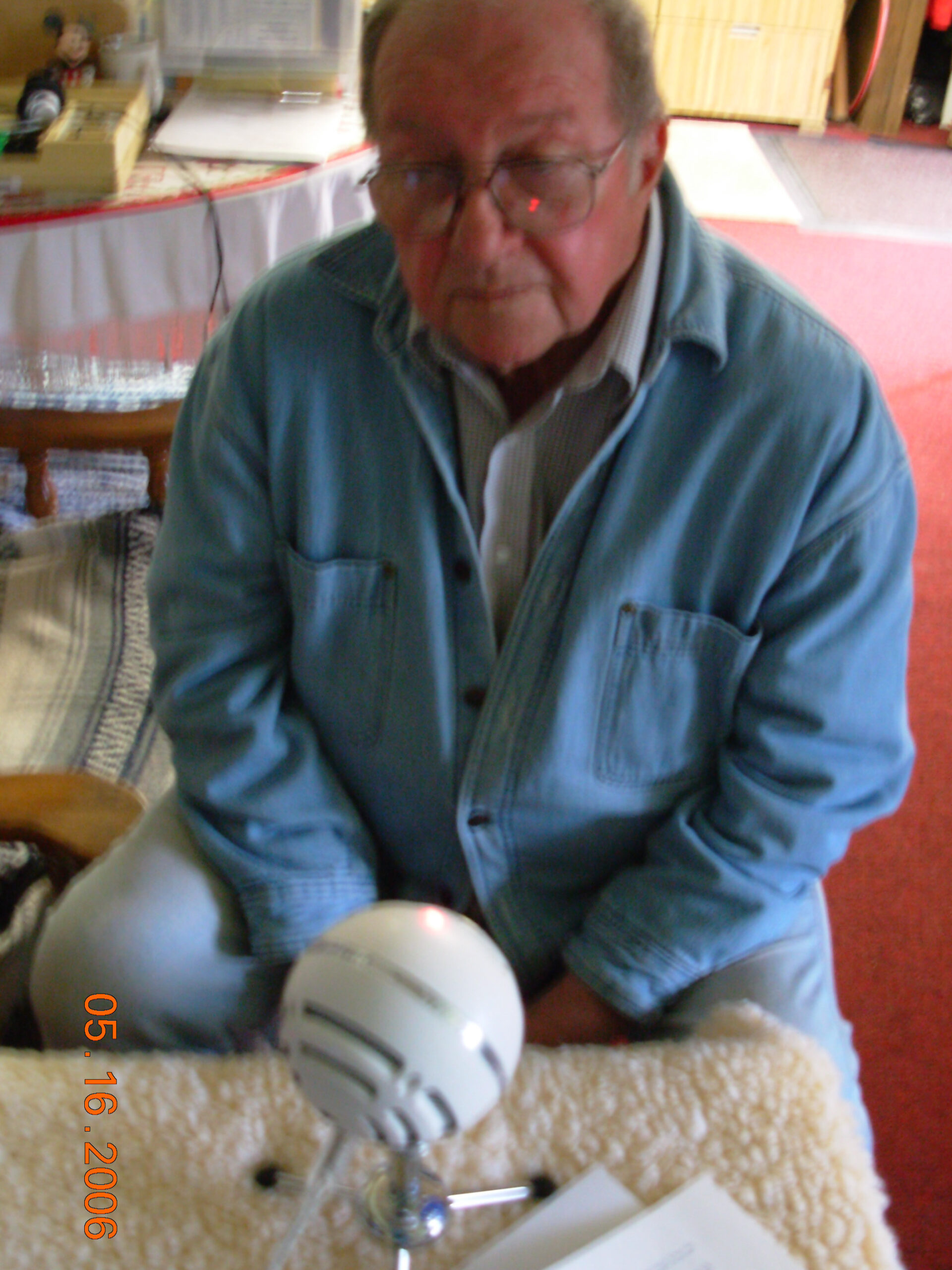
Ed Mitchell
At home
May 16, 2006
Ed Mitchell was Walter Dixon’s favorite engineer. They met when Walter joined WBBF (formerly WARC) in 1954. Later, they both moved to WHAM; Ed in 1958 and Walter in 1959.
During the late 1950s, Walter met jazz organist/pianist, Doug Duke, and convinced Doug to bring his talent to WHAM.
Together, Walter, Ed and Doug formed DEW Productions (D for Doug, E for Ed and W for Walter). Under DEW’s banner, they created a number of quality radio programs including:
- The Time Between
- Segments of the two hour program called COMPOSITE
- Dozens of the award winning public service programs called JUSTICE which defined and illustrated various points of New York State law.
When Ed left WHAM in 1968 to join Eastman Kodak Company, Walter experienced it a great personal and professional loss.
We have divided the interview tracks according to:
- Ed’s WARC/WBBF days when WARC became WBBF
- Ed’s WHAM days
- Ed’s Eastman Kodak days.
- Doug Duke’s days at WHAM
Track 0: Full interview edited
ED’S WARC/WBBF DAYS
Track 1. Ed began his career at WARC/WBBF
Track 2. Ed’s changing shifts at WBBF
Track 3. Who was on mornings and afternoons?
Track 4. Producing Cunningham’s theme song and more?
Track 5. Learning how to be an engineer
Track 6. Town of Brighton’s gas leak explosions
Track 7. Their on air evening programs and a remembered tale about Walter
Track 40. Mort Nusbaum at WBBF and WSAY
ED’S WHAM DAYS
DEW PRODUCTIONS AND THE PROGRAMS IT PRODUCED
Track 10. The formation of DEW Productions
Track 23. More about Dew Productions
Track 8. The Justice programs
Track 16. The Composite Show
Track 9. Set up for the Time Between Program
Track 17. More about the Time Between program
Track 38. How long were you recording The Time Between program?
Track 39. Working in Studio B on Humboldt Street
Track 12. About Earle Jerris and his shows
Track 13. About Bill Dwyer: He started at WBBF and then when to WHAM
Track 14. Louise Wilson was fun to work with.
Track 15. Editing tapes at WHAM and Kodak
Track 18. Ed’s duplicate tapes
Track 19. Walter’s live RPO productions
Track 20. Ed left WHAM in 1968
Track 21. Changes at WHAM
Track 22. First stereo Broadcast from Humboldt Street
Track 23. New Program Director, Bill Givens
Track 24. How Doug Duke came to WHAM
Track 26. Nationally famous, Foster Brooks
Track 27. Foster Brooks and Jack Slattery
Track 28. Ed was laid off during his early days at WHAM
Track 29. About Foster Brooks
Track 34. Doug’s organ stayed at WHAM
DOUG DUKE’S DAYS AT WHAM
TRACK 32. The importance of Gene Tibbles’ garage
TRACK 36. What do you remember about Doug Duke?
TRACK 37. More about Doug Duke
ED’S DAYS AT KODAK
Track 30. More on Jack Slattery’s work at Kodak
Track 33. Ed describes his work at Kodak